Search this blog

05 February, 2017

Engineering for squishy bags of meat

The section you can skip

I'm Italian, and I grew up in a family of what you could call middle-class intellectuals. My parents came from proletarian families, and were the first generation being university educated, not working in the fields. 
A teacher and a doctor, embedded in the life of the city and involved in local politics; we used to often host people over for dinner. And I remember, at the time, being fairly annoyed at how people could be highly regarded for their knowledge and intelligence even if they were limited to the sole study of the humanities, without knowing even the basics of math, or scientific thinking.

Fast forward and today, as a computer science professional, society in my small bubble seems to have undergone a (non-violent) cultural revolution. Today "nerds" are considered "smart", the lack of social skills almost a badge of honor, and things seem to matter only when they relate to quantifiable numbers.

Not always, I have to say the professional world of smart computer scientists is not a stereotyped as your average Hollywood portrayal, yet too often we live in a world that is yet again too vertical: programmers, artists, managers, often snarking at the other categories lack of "skills".

"We wanted to build an elegant, robust, and beautiful product"

I've been wanting to write this post for a while now, I have various sketches in my notebook from almost a year ago, but recently I found this very well written post-mortem analysis of RethinkDB failure as a startup. I'm no database expert, but what I found particularly interesting is the section talking about the design principles behind their product.

You want to make a new database product; what is that you're going to focus on? For RethinkDB, the answer was three key factors: correctness, simplicity of interface and consistency.
Seems pretty reasonable, databases are the central infrastructure for most of today's applications, and who would like to build a billion-dollar product on something that doesn't guarantee correct operation? And definitely, today's startups need to move fast and are willing to adopt whatever new technology that helps to get results fast, so simplicity and consistency could give a competitive advantage.

Of course, it's no surprise as they were talking candidly about the reasons why the failed, that these were "the wrong metrics of goodness" (their words). What did people want? According to the article, the right metrics would have been: timely arrival, "palpable" speed (benchmarks, marketing), and a good use case. In other words, a product that:

1) Solved a problem (use case)
2) Now (timely arrival)
3) While making people happy (the importance of perceived performance)

This misjudgment led not only to the demise of the startup but also to a lot of frustration, depression, and anger, as what could be seen as inferior products made big impacts in the market.

Clash of worlds

The sin is, of course, the idea that an abstract notion of beauty matter at all. We write software to achieve given results, and these results are for all but the most theoretical of works, something that somehow has to make people happy. 
Everything else is just a mean towards that, a tool that can be used well or not but not a goal. The goal is always to sell to your market, to do something that people will... like. 
It requires understanding your customers and understanding that we are all people. It's the clash between "features" and "experiences".

When we think about features it's easy to end up in the measurement fallacy. We are doing X, and we are doing X measurably better for certain axes of measurement than another product, thus, we are better. Wait for adoption and success.
This is the peril of living in a verticle bubble of knowledge. People in tech think about tech, we work with it, we create it, it's easy and to a degree even inevitable to start technology for technology's sake.

But the truth is that user experience, workflows, and subjective experiences are about technology, and they are about research and computer science. 
They are just -harder- problems to solve, problems that most often have no good metric to optimize at all, sometimes because we don't know how to measure "soft" qualities, but many times because these qualities are truly hard to isolate. 
Better evolves through "blind" iteration and luck, and it's subject to taste, to culture, to society. Look at all the artifacts around you. Why is a musical instrument better than another one? Or a movie, game, car, pen, table, phone... 

Good design is humanistic in nature, we have to understand people, what they like, what they fear, how they use technology, how much they can adapt to change, what risks they evaluate. Objectively good is not good enough. Good design makes objective sense but overcomes also emotional, social, environmental obstacles.

Computer Science should be taught together with sociology, psychology, design, interactive arts.

Specialization

To be fair though it's not surprising that people who are deeply invested in a given field, don't fare well in others. The tension between vertical knowledge, specialization, and horizontal knowledge that allows us to be well-rounded, is ineluctable. 
We are more and more pushed towards specialization because our fields are so deep and complex, and even the most brilliant minds don't have infinite mental resources, so there are always tradeoffs to be made.

Whether you went to a university or not, chances are that to become a specialist you needed a deep, technical immersion in a given field. We isolate ourselves into a bubble, and to a degree, we need to.
The real problem begins when we start thinking that a given bubble is representative of the world, that because given qualities matter inside it, they actually do matter.
When that starts, then we start adopting the wrong metrics to judge the world, and we end up frustrated when the world doesn't respond to them. 

Bubbles are of course a very general problem, even a very scary one when you think that really our world is becoming more and more complex to the degree that's not easily explicable even by experts, it's not easy to encapsulate in a set of rules. Complexity can push us inwards, to simplistic explanations and measure of goodness that we can become very attached to, even if they are very narrow-sighted.

It doesn't help that we, as humans, seek confirmation more than truth.

Academic research

Take for example the world of academia and scientific research. Researchers are judged on novelty, what a paper really needs is a measure, then, given such measure one can assert that a given technique is objectively better in a given context. 
If something is better, but not in a way that is easily measured, it's not something that can be easily published. This is not per se a terrible problem, it becomes a problem when we start thinking that these measures are all that really matters. 

I work in computer graphics; if I make a new system that generates simplified 3d models, and all the artists that use it think it's revolutionary, it produces a much better output and it's easier to use than anything else, did I make something novel and noteworthy? Surely yes, that's, in fact, all that matters.
But if this notion of how much better it is can't be measured in some kind of metric, it's not something that can be considered a novel research in academic terms. This is the nature of applied research, but it also creates a disconnect between academia and the rest of the world: a bubble, that we have to be aware of. 

When we ignore the existence of the bubble, frustration arises. Industry professionals are frustrated when academic research doesn't end up "working" for their needs. And researchers are frustrated when they see the industry "lagging behind" the theoretical state of the art.

Conclusions

Is it all bleak? To a degree, yes, it is when you realize that the world is not easily reducible to comforting measures that we like. That biases are inevitable, that specialization is inevitable and bubbles are inevitable.
I say that "experience is a variance reduction technique", we become more predictable and entrenched, better, at doing something, but we pay a price to it.

What we can certainly do though is to at least -aware- of these mechanisms. Doubt ourselves. Know that what we think it matters, might not matter at all, and seek different point of views. Know that what we think is rational, most of the times is just a rationalization. Be aware of the emotional factors in our own choices.

What we can certainly do is to break -a bit- out of our vertical pits of knowledge, and be just curious enough, learn just enough to be able to interface with different people. That can be just the solution we need, we can't know all, and we can't really understand the world without any filter. We can though make sure we are able to talk and engage with people that are different, that invested their verticality in other fields.

In the end, personally, I don't consider my journey towards being truly "smart" complete or even really started. But at least I am a bit aware... I also have the gift of a spouse that beats me down showing me how bad I still am at many aspects of "smartness", and a strong enough ego to take that beating. Small steps.

26 October, 2016

Over-engineering (the root of all evil)

Definitions

Over-engineering: using prematurely for tools, abstractions or technical solutions, resulting in wasted effort and unnecessary complexity.


When is a technique used prematurely? When it doesn't solve a concrete, current problem. It is tempting to define good engineering in terms of simplicity or ease of development, but I think it's actually a slippery slope. Simplicity means different things to different people. 


One could see programming as compression (and indeed it is), but we have to realize that compression, or terseness, per se, is not a goal. The shortest program possible is most often not the simplest for people to work with, and the dangers of compression are evident to anybody that had to go through a scientific education: when I was in university the exams that were by far the most difficult came with the smallest textbooks...


Simplicity also means different things to different people. To someone in charge of low-level optimizations working with fewer abstractions can be easier than having to dive through many software layers. To a novice, a software written in a more idiomatic way for a given language might be much easier than something adapted to be domain specific.


Problems, on the other hand, measurable, concrete issues, are a better framework. 

They are still a soft, context-dependent and team-dependent metric, but trying to identify problems, solutions, and their costs brings design decision from an aesthetic (and often egocentric) realm to a concrete one.
Note: This doesn't mean that good code is not or shouldn't be "beautiful" or elegant, but these are not goals, they are just byproducts of solving certain problems the code might have.
Also, "measurable" does not mean we need precise numbers attached to our evaluations, in practice, most things can't be better than fuzzy guesses, and that's perfectly fine.

Costs and benefits


Costs are seldom discussed. If a technique, an abstraction, an engineering solution doesn't come with drawbacks, it's probably because either it's not doing much, or because we've not been looking hard enough. 

  • Are we imposing a run-time cost? What about the debug build? Are we making it less usable?
  • Are we increasing build-times, lowering iteration times? 
  • A human one, in terms of complexity, obfuscation, ability to on-board new engineers?
  • Are we making the debugging experience worse? Profiling?
  • Do our tools support the design well? Are we messing up with our source control, static analyzer and so on?
  • Are we decreasing code malleability? Introducing more coupling, dependencies? 
  • Reducing the ability to reason locally about code? Making details that matter in our context hidden at call-site? Making semantics less explicit, or less coupled to a given syntax? Violating invariants and assumptions that our code-base generally employs?
  • Does it work well with the team culture? With code reviews or automated testing or any other engineering practice of the team?
We have to be aware of the trade-offs to discuss an investment. But our tendency to showcase the benefits our ideas and hide the costs is a real issue in education, in research, in production. It's hardwired in the way we work. It's not (most often) even a matter of malice, it's simply the way we are trained to reason, we seek success and shy away from discussing failure.

I've seen countless time people going on stage, or writing articles and book, honestly trying to describe why given ideas are smart and can work while totally forgetting the pain they experience every day due to them.


Under-engineering


And that's why over-engineering truly is the root of all evil. Because it's vicious, it's insidious, and we're not trained at all to recognize it. 


It is possible to go out and buy technical books, maybe go to a university, and learn tens or hundreds of engineering techniques and best practices. On the other hand, there is almost nothing, other than experience and practice, that teaches restraint and actual problem solving.


We know what under-engineering is, we can recognize duplicated code, brittle, and unsafe code, badly structured code. We have terminology, we have methodologies. Testing, refactoring, coverage analysis...


In most of the cases, on the other hand, we are not trained to understand over-engineering at all.

Note: In fact over-engineering it's often more "pronounced" in good junior candidates, whose curiosity lead them to learn lots of programming techniques, but that have no experience in their pitfalls and can easily stray from concrete problem solving.

This means most of the times when over-engineering happens it tends to persist, we don't go back from big architectures and big abstractions to simpler systems, we tend to build on top of them. Somewhere along the road, we made a bad investment, with the wrong tradeoffs, but now we're committed to it.


Over-engineering tends to look much more reasonable, more innocent than under-engineering. It's not bad code. It's not ugly code. It's just premature and useless, we don't need it, we're paying a high price for it, but we like it. And we like technology, we like reading about it, keeping ourselves up-to-date, adopting the latest techniques and developments. And at a given point we might even start thinking that we did make the right investment, that the benefits are worth it, especially as we seldom have objective measures or our work and we can always find a rationalization of almost any choice.


I'd say that under-engineering leads to evident technical debt, while over-engineering creates hidden technical debt, which is much more dangerous. 


The key question is "why?". If the answer comes back to a concrete problem with a positive ROI, then you're probably doing it right. If it's some vague other quality like "sharing", "elegance", "simplicity", then it's probably wrong, as these are not end goals.

When in doubt, I find it's better to err on the side of under-engineering, as it tends to be more productive than the opposite, even if it is more reviled.


"Premature optimization is the root of all evil" - Hoare, popularized by Knuth.

I think over-engineering is a super-set of premature optimization. In the seventies, when this quote originated, that was the most common form of this more "fundamental" evil.
Ironically, this lesson has been in the decades so effective that nowadays it actually helps over-engineering, as most engineers read it incorrectly, thinking that in general performance is not a concern early on in a project.


Intermission: some examples


- Let's say we're working on a Windows game made in Visual Studio. Let's say that you are using a Visual Studio solution and it's done badly, it uses absolute paths and requires the source-code and maybe some libraries to be in a specific directory tree on the hard drive. Anybody can tell that's a bad design, and the author might be scorned for such an "unprofessional" choice, but in practice, the problems that it could cause are minimal and can be trivially fixed by any programmer.


On the other hand, let's say we started using, for no good reason, a more complex build system, maybe packages and dependencies based on a fancy new external build tool of the week.

The potential cost of such a choice is huge because chances are that now many of your programmers aren't very familiar with this system, it's bringing no measurable benefits but now you've obfuscated an important part of your pipeline. Yet, it's very unlikely that such decision will be derided.

- Sometimes issues are even subtler, because they involve non-obvious trade-offs. A fairly hard-coded system might be painful in terms of malleability, maybe doing changes in this subsystem requires every time editing lots of source files even for trivial operations.


We really don't like that, so we replace this system with a more generic, data-driven one which allows to do everything live, doesn't even require to recompile code anymore. But say that such system was fairly "cold", and the changes were actually infrequent. Suppose also that the new system takes a fair amount more code and now our entire build is slower. We ended up optimizing a workflow that was infrequent but on the down side we slowed down the daily routine of all our programmers on the team...

- Let's say you use a class where you could have used a simple function. Maybe you integrate a library, where you could have written a hundred lines of code. You use a templated container library where you could have used a standard array or ad-hoc solutions. You were careless and now your system is becoming more and more coupled at build-time due to type dependencies. 

It's maybe a bit slower in runtime than it could be or it makes more dynamic allocations than it should, or it's slow in debug builds, and it makes your build time longer while being quite obscure when you actually have to step in this library code.

This is a very concrete example, happens often yet chances are that none of this will be recognized as a design problem, and we often see complex tools built on top over-engineered designs to "help" solving their issues. So now you might use "unity builds" and distributed builds to try to remedy the build time issues. You might start using complex memory allocators and memory debuggers to track down what's causing fragmentation and so on and so forth. 


Over-engineering invites more over-engineering. There is this idea that a complex system can be made simpler by building more on top of it, which is not very realistic.


Specialization and constraints


I don't have a universal methodology for evaluating return on investment, once the costs and benefits of a given choice are understood. And I think there isn't in general one because this metric is very context sensitive. What I like to invite engineers to do is to think about the problem, be acutely aware of it.


One of the principles I think is useful as a guidance is that we operate with a finite working set: we can't pay attention to many things at the same time, we have to find constraints that help us achieve our objectives. In other words, our objectives guide how we should specialize our project.


For example, in my job I often deal with numerical algorithms, visualization, and data exploration. I might code very similar things in very different environments and very different styles depending on the need. If I'm exploring an idea, I might use Mathematica or Processing. 

In these environments, I really know little about the details of memory allocations and the subtleties of code optimization. And I don't -want- to know. Even just being aware of them would be a distraction, as I would naturally gravitate towards coding efficient algorithms instead of just solving the problem at hand.

Often times my Mathematica code actually leaks memory. I couldn't care less when running an exploratory task overnight a workstation with 92 gb of ram. The environment completely shields me from these concerns and this is perfect, it allows me to focus on what matters, in that context. I write some very high-level code, and somehow magic happens.


Sometimes I have to then port these experiments to production C++ code. In that environment, my goals are completely different. Performance is so important to us that I don't want any magic, I want anything that is even remotely expensive to be evident in the location where it happens. If there was some magic that worked decently fast most of the times, you can be sure that the problems it creates would be lost until there are so many locations where that happens that the entire product falls apart.


I don't believe that you can create systems that are extremely wide, where you have both extremely high-level concerns and extremely low-level ones, jack-of-all-trades. Constraints and specialization are key to software engineering (and not only), they allow us to focus on what matters, keeping the important concerns in our working set and to perform local reasoning on code.


All levels


Another aspect of over-engineering is that it doesn't just affect minute code design decisions or even just coding. In general, we have a tendency to do things without proper awareness, I think, of what problems solve for us and what problem they create. Instead, we're often guided either by a certain aesthetic or certain ideals of what's good.


Code sharing for example and de-duplication. Standards and libraries. There are certain things that sometimes we consider intrinsically good, even when we have a history of failures from which we should learn. 


For engineering, sharing in particular is something that comes with an incredible cost but that is almost always considered a virtue per se, even by teams which have experience actually paying the price in terms of integration costs, of productivity costs, of code-bloat and so on, it came to be just considered "natural".


"Don't reinvent the wheel" is very true and sound. But "the wheel" to me means "cold", infrastructural code that is not subject to iteration, that doesn't need specialization for a given project. 

Thinking that sharing and standardization is always a win is like thinking that throwing more people at a problem is always a win, or that making some code multithreaded is always a win, regardless of how much synchronization it requires and how much harder it makes the development process...

In a videogame company, for example, it's certainly silly to have ten different math libraries for ten different projects. But it might very well not be silly to have ten different renderers. Or even twenty for what matters, rendering is part of the creative process, it's part of what we want to specialize, to craft to a given art-direction, given project scope and so on.


People


Context doesn't matter only on a technical level, but also, or perhaps even more, on a human level. Software engineering is a soft science!


I've been persuaded of this having worked for a few different projects in a few different companies. Sometimes you see a company using the same strategy for similar projects, only to achieve very different results. Some other times on the other hands, similar results are obtained by different products in different companies by employing radically different, almost opposite strategies. Why is that?


Because people matter more than technology. And this is perhaps the thing that we, as software engineers, are trained the least to recognize. People matter more than technology.


A team of veterans does not work the same as a team that has or needs a lot of turnover. In the game industry, in some teams innovation is spearheaded by engineers, in some others, it's pushed by artists or technical artists.

A given company might want to focus all their investment in a few, very high profile products, where innovation and quality matters a lot. Another might operate by producing more products and trying to see what works, and in that realm maybe keeping costs down matters more.

Even the mantras of sharing and avoiding duplication are not absolute. In some cases, duplication actually allows for better results, e.g. having a separate environment for experimentation than final production. In some cases sharing stifles creativity, and has upkeep costs that overall are higher than the benefits.


It's impossible to talk about engineering without knowing costs, benefits, and context. There is almost never a universally good solution. Problems are specific and local.

Engineering is about solving concrete problems in a specific context, not jumping carelessly on the latest bandwagon.

Our industry I feel, still has lots to learns.

21 October, 2016

Cinematography, finally!

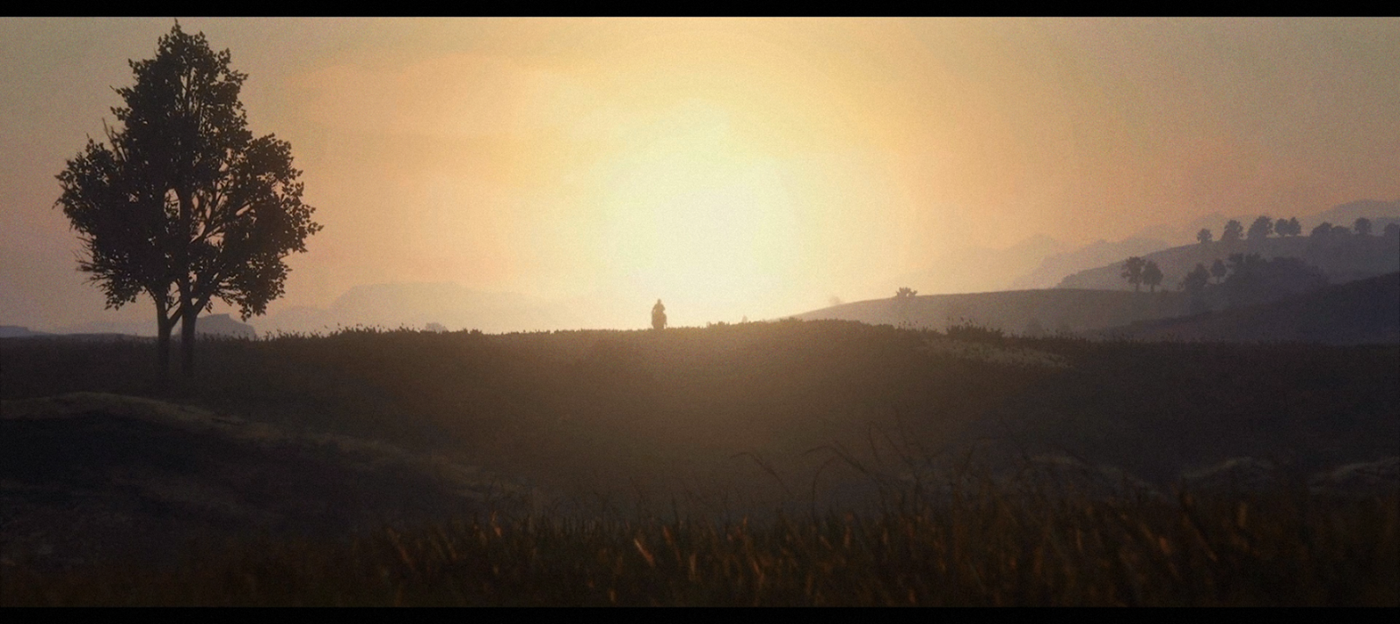
I made some screen grabs from the recently released Red Dead Redemption 2 announcement trailer.

These were quite hastily and heavily processed (sorry) in an attempt to make the compression artifacts from the video show less.

Basically these are an average of 5-6 frames, a poor man's temporal anti-aliasing let's say (and the general blurring helps not to focus on the general balance of the image instead of being distracted by small details), and tons of film grain to hide blocking artifacts.

I am in love. Tasteful, amazing frames that don't look like something that was just arbitrarily color-graded to make it seem somewhat cool last minute like a bad Instagram filter.

Enjoy. Ok, let me spend a couple more words...

Some made this to be a technical comparison between titles. In a way it is, but it's not a comparison on resolution and framerate, or amount of leaves rendered, texture definition and so on.

In all these accounts I'm sure there are plenty of engines that do great, even better than RDR2, especially engines made to scale to PC.

Thing is, who cares? This shouldn't matter anymore. We're past the point where merely draw more pixels or more triangles is where technology is at. We're not writing tri-fillers, we're making images. Or at least, we should be.

Technology should be transparent. Great rendering should not show, great rendering happens when you can't point your finger and name a given feature, or effect implementation. We are means to and end, the end is what matters. And it is a matter of technology, or research and of optimization. But a different one.

It is absolutely easier to push a million blades of grass on screen than to make a boring, empty room that truly achieves a given visual goal.

It is absolutely easier to make a virtual texturing system that allows for almost one-to-one texel to pixel apparent resolution than to accurately measure and reproduce a complex material.

It is absolutely easier to make a hand optimized, cycle-tight uber post-effect pipeline than to write artists tools for actual rapid iteration and authoring of color variants in a scene.

I'm not claiming that this particular game does any of these things right. Maybe it's just great art direction. Maybe it's achieved by lots of artists iterating on the worst engine and tools possible. Or maybe it's years of R&D, it's very hard to tell, even more from a teaser-trailer (albeit it totally looks legit real-time on the platform). But that's the point, great rendering doesn't show, it just leaves great images.

And I hope that  more and more games (RDR is certainly not the only one) and art departments and engineers do realize that, the shift we're seeing. Rendering hasn't "peaked" for sure, but we need to shift our focus more and more towards the "high level".

We solve concrete problems, technology otherwise is useless. And, yes, that means that you can't do good tech without artists because you won't ever have great images without great art. Working in isolation is pointless.

And now... Enjoy!


The first Red Dead Redemption also holds up quite well all things considered... These are respectively from the introduction cinematic and one of the first missions:


And as "bonus images", some screens I've found from the recent Battlefield 1 and The Witcher 3.


01 October, 2016

More (silly) tone-mapping ideas

As a follow-up to my previous post I'll show here two more tone-mapping tricks. They are both "silly" in a way, they were done quickly and mostly while waiting for more important things to build, so they are far from "production quality".

They both are somewhat inspired by photography (but make no effort at all to simulate photographic effects, rather, they take inspiration from observing how certain things work), and I believe they could all be part (including the ideas of the previous post) of a single tone-mapping operator. 
All dynamic range compression algorithms have trade-offs and artifacts, so I believe it's not unwise to layer various methods each doing just a bit of compression, to achieve an overall larger reduction.

"Adaptive ND-Filter"

The idea of doing this test came from a discussion with my Italian friend Manuele Bonanno, as we were chatting about Bart's TM post (which I linked in the previous article).

In landscape photography is not uncommon to use graduated neutral density filters. A ND filter reduces all wavelengths of light equally, darkening the image without shifting colors, and can be used for particular effects like very long exposures or to be able to use wide lens apertures in daylight. 
A graduated ND filter does the same but using a gradient, and it's used typically to darken the sky (top half) relative to the other elements of the image.


A GND filter - from Tiffen Filters marketing material

The interesting thing to notice is that even if in photography these filters are made with a fixed gradient, in practice the effect is smooth enough that it can make a big difference on the final image without being noticeable. 
Our vision system is not good at detecting very low-frequency gradients in images, so after a given spatial frequency we can "cheat" liberally without being able to see artifacts.

How to apply this in computer graphics is rather obvious: let's just blur everything a lot and use that as a base for a localized tone-mapping operator (in the test below, I just scale the exposure by the blurred version of the image a bit, then apply global TM as usual).

Doing local tone-mapping with a gaussian blur average usually yields pretty strong haloing artifacts (and a lot of photographic HDR toning software actually is plagued by such halos), and my previous article tried to show an alternative that is both stupidly cheap and that can't result in haloing (as it's not using neighboring operators at all).


Without ND
With ND (save the images and A/B them by alternating the two)

The "insight" here is that you can also prevent haloing if you use gaussian blur, but you blur enough not to be at frequencies where haloing shows. And, of course, if you have a good quality bloom/veil effect, you can re-use the image pyramids from that almost directly. Just remember to apply a -neutral- (grayscale) ND!


The gaussian filter approximated with image pyramids

Used tastefully and in a temporally stable way I think it can work, and indeed my colleague Michal confirmed that he know of titles doing something similar. 
I did a quick test using COD:AW and the effect indeed works really well, actually even better indoors than outdoors often, reducing the amount of "auto-exposure" needed (which we don't push very far typically anyways).

Film Grain

What? Film grain is not about dynamic range, right? It's usually an artistic effect, at best it can be seen as a dithering method that can help avoiding Mach band artifacts. Right?


A detail from a film photo by Trent Parke

Well, not really. If you look at an actual photo you'll notice that grains mostly show in midtones, or rather, that pure whites and pure blacks either saturate grains or have no grains exposed, and thus appear as solid regions.


Thresholded version

This means that if we look at a thresholded version of a good film scan we can see a spatial dithering in the threshold. 
We have some black areas that have black grains but are not fully saturated with black, and then we have "blacker than black" areas where the same black grains appear spatially clustered to create an entirely saturated region (and the same happens in the highlights as well). 

This suggests that we can use dithering patterns not only to get more precision in the midtones, but also to extend a bit the range of highlights and shadows. If a dither pattern is symmetric and equally distributed around zero (as it should be), sometimes it will add luminosity and sometimes it will subtract it. 
So if an area is white, but not whiter-than-white, the times the pattern subtracts it will create darker pixels. In areas that are constantly whiter than the intensity of the dither, even after subtraction, we will still end up with a full white, and we will see saturated areas. 


The image above is a quick test of the theory. On the left, it uses just the simple, old good Reinhard tone-mapping (with black and white levels used to get contrast). The image on the right uses the exact same tone-mapping but also adds som RGB film grain. 
If you look at the shadows and the highlights you can notice that there is a bit more detail visible in the film-grain version (e.g. count the number of visible beams in the glass ceiling).

This is just a quick test, I tweaked the film grain actually to be less intense in the midtones (around 0.5) than near the extremes (0 and 1) to be able to push it a bit further without being too intense over the entire image. It can certainly be done in much better ways, but as far as silly experiments go, I'm rather happy. 
If you really wanted to be cheating, you could even just add grain in the shadows, which would definitely be a hack as you're adding energy but hey... it's not that we don't routinely do that (e.g. bloom/veil usually doesn't redistribute energy, it just adds it...)

P.s. real film grain is actually not easy to emulate (and I'm not trying to, here). This is the only attempt I know of.

11 September, 2016

Tone mapping & local adaption

My friend Bart recently wrote a series of great articles on tone mapping, showing how localized models can be useful in certain scenarios, and I strongly advise to head over to his blog to read that one first, which motivated me to finally dump some of my notes and small experiments on the blog...

Local tone mapping refers to the idea of varying the tone mapping per pixel, instead of applying a single curve globally on the frame. Typically the curve is adapted by using some neighborhood-based filter to derive a localized adaption factor, which can help preserve details in both bright and dark areas of the image.

At the extreme, local operators give the typical "photographic HDR" look, which looks very unnatural as it's trying to preserve as much texture information possible at the detriment of brightness perception.

HDR photography example from lifehacker

While these techniques help display the kind of detail we are able to perceive in natural scenes, in practice the resulting image only exacerbates the fact that we are displaying our content on a screen that doesn't have the dynamic range that natural scenes have, and the results are very unrealistic.

That's why global tonemapping is not only cheaper but most often appropriate for games, as we aim to preserve the perception of brightness even if it means sacrificing detail.
We like brightness preservation so much in fact, that two of the very rare instances of videogame-specific visual devices in photorealistic rendering are dedicated to it: bloom and adaption.


Veiling glare in COD:AW

Most of photorealistic videogames still, and understandably, borrow heavily from movies, in terms of their visual language (even more so than photography), but you will never see the heavy-handed exposure adaption videogames employ, in movies, nor you'll see what we usually call "bloom", normally (unless for special effect, like in a dreamy or flashback sequence).

Of course, a given amount of glare is unavoidable in real lenses, but that is considered an undesirable characteristic, an aberration to minimize, not a sought-after one! You won't see a "bloom" slider in lightroom, or the effect heavily used in CG movies...


An image used in the marketing of the Zeiss Otus 24mm,
showing very little glare in a challenging situation

Even our eyes are subject to some glare, and they do adapt to the environment brightness, but this biological inspiration is quite weak as a justification for these effects, as no game really cares to simulate what our vision does, and even if that was done it would not necessarily improve perceived brightness, as simulating a process that happens automatically for us on a 2d computer screen that then is seen through our eyes, doesn't trigger in our brain the same response as the natural one does!


Trent Parke

So it would seem that all is said and done, and we have a strong motivation for global tonemapping. Except that, in practice, we are still balancing different goals!
We don't want our contrast to be so extreme that nothing detail can be seen anymore in our pursuit of brightness representation, so typically we tweak our light rigs to add lights where we have too much darkness, and dim lighting where it would be too harsh (e.g. the sun is rarely its true intensity...). Following cinematography yet again.

Gregory Crewdson

How does local tone mapping factor in all this? The idea of local tone mapping is to operate the range compression only at low spatial frequency, leaving high-frequency detail intact. 
One one hand this makes sense because we're more sensitive to changes in contrast at high-frequency than we are at lower frequencies, so the compression is supposed to be less noticeable done that way.

Of course, we have to be careful not to create halos, which would be very evident, so typically edge-aware frequency separation is used, for example employing bilateral filters or other more advanced techniques (Adobe for example employs local laplacial pyramids in their products, afaik).

But this kind of edge-aware frequency separation can be also interpreted in a different way. Effectively what it's trying to approximate is an "intrinsic image" decomposition, separating the scene reflectance from illuminance (e.g. Retinex theory).

So if we accept that light rigs must be tweaked compared to a strict adherence to measured real scenes, why can't we directly change the lighting intensity with tone mapping curves? And if we accept that, and we understand that local tonemapping is just trying to decompose the image lighting from the textures, why bothering with filters, when we have computed lighting in our renderers?

This is a thought that I had for a while, but didn't really put in practice, and more research is necessary to understand how exactly one should tone-map lighting. But the idea is very simple, and I did do some rough experiments with some images I saved from a testbed.

The decomposition I employ is trivial. I compute an image that is the scene as it would appear if all the surfaces where white (so it's diffuse + specular, without multiplying by the material textures) and call that my illuminance. Then I take the final rendered image, divide it by the illuminance to get an estimate of reflectance.

Note that looking at the scene illuminance would also be a good way to do exposure adaption (it removes the assumption that surfaces are middle gray), even if I don't think adaption will ever by great done in screen-space (and if you do so, you should really look at the anchoring theory), better to look at more global markers of scene lighting (e.g. light probes...).


Once you compute this decomposition, you can then apply a curve to the illuminance, multiply the reflectance back in, and do some global tone mapping as usual (I don't want to do -all- the range compression on the lighting). 


Standard Reinhard on the right, lighting compression on the left.
The latter can compress highlights more while still having brighter mids.

I think with some more effort, this technique could yield interesting results. It's particularly tricky to understand what's a proper midpoint to use for the compression, and what kind of courve to apply to the lighting versus globally on the image, and how to do all this properly without changing color saturation (an issue in tone mapping in general), but it could have its advantages.

In theory, this lies somewhere in between the idea of changing light intensities and injecting more lights (which is still properly "PBR"), and the (bad) practices of changing bounce intensity and other tweaks that mess with the lighting calculations. We know we have to respect the overall ratios of shadow (ambient) to diffuse light, to specular highlights (and that's why tweaking GI is not great). 
But other than that, I don't think we have any ground to say what's better, that's to say, what would be perceptually closer to the real scene as seen by people, for now, these are all tools for our artists to try and figure how to generate realistic images.

I think we too often limit ourselves by trying to emulate other medias. In part, this is reasonable, because trying to copy established visual tools is easier both for the rendering engineer (less research) and for the artists (more familiarity). But sooner or later we'll have to develop our own tools four our virtual worlds, breaking free of the constraints of photography and understanding what's best for perceptual realism.

"Conclusions"

Adding lights and changing the scenes is a very reasonable first step towards dynamic range compression: effectively we're trying to create scenes that have a more limited DR to begin with, so we work with the constraints of our output devices.

Adding fill lights also can make sense, but we should strive to create our own light rigs, there's very little reason to constrain ourselves to point or spots for these. Also, we should try to understand what could be done to control these rigs. In movies, they adapt per shot. In games we can't do that, so we have to think of how to expose controls to turn these on and off, how to change lighting dynamically.

Past that, there is tone-mapping and color-grading. Often I think we abuse of these because we don't have powerful tools to quickly iterate on lighting. It's easier to change the "mood" of a scene by grading rather than editing light groups and fill lights, but there's no reason for that to be true! 
We should re-think bloom. If we use it to represent brightness, are the current methods (which are inspired by camera lenses) the best? Should we experiment with different thresholds, with maybe subtracting light instead of just adding it (e.g. bring slightly down the scene brightness in a large area around a bright source, to increase contrast...).
And also, then again, movies are graded per shot, and by masking (rotoscoping) areas. We can easily grade based on distance and masks, but it's seldom done.

Then we have all the tools that we could create beyond things inspired by cinematography. We have a perfect HDR representation of a scene. We have the scene components. We can create techniques that are impossible when dealing with the real world, and there are even things that are impractical in offline CGI which we can do easily on the other hand. 
We should think of what we are trying to achieve in visual and perceptual terms, and then find the best technical tool to do so.